 Meteoraag
 fee sharing through fixed recipient splits
Meteoraag lets teams distribute a funded token balance through fixed recipient shares using Dynamic Fee Sharing on Solana. Each vault covers one token mint and holds two to five recipient entries. Funding creates claimable allocations, which recipients collect with the wallets assigned to their entries. The arrangement suits fee streams with a stable recipient list, including supported DAMM v2 and Dynamic Bonding Curve integrations. Later changes to the split require a new vault.
- updatedFee vaults connect balances with recipient entries
The fee vault stores the distribution rules, while a program-controlled token account holds the funded assets. Each recipient entry contains a wallet address, share amount and claim checkpoint. The vault also records the token mint and total shares, connecting that common balance with the allocations that recipients can claim.
Teams can allocate eligible revenue to creator, launchpad, treasury or contributor wallets. Recipient entries connect those roles with the addresses that can claim the funded tokens.
How does funding become claimable?
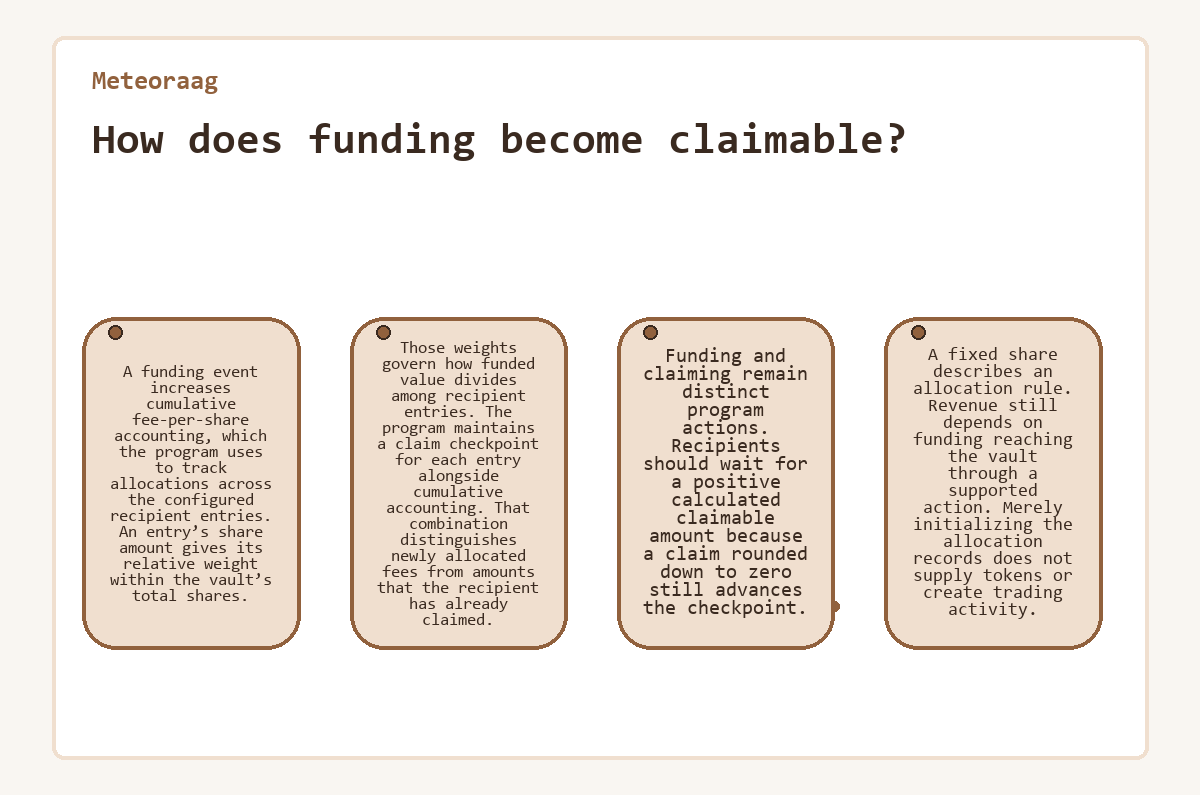
A funding event increases cumulative fee-per-share accounting, which the program uses to track allocations across the configured recipient entries. An entry’s share amount gives its relative weight within the vault’s total shares. Those weights govern how funded value divides among recipient entries.
The program maintains a claim checkpoint for each entry alongside cumulative accounting. That combination distinguishes newly allocated fees from amounts that the recipient has already claimed. Funding and claiming remain distinct program actions. Recipients should wait for a positive calculated claimable amount because a claim rounded down to zero still advances the checkpoint.
A fixed share describes an allocation rule. Revenue still depends on funding reaching the vault through a supported action. Merely initializing the allocation records does not supply tokens or create trading activity.
Recipient wallets authorize claims by entry index
A claim requires the signer to match the recipient address at the supplied entry index. The index identifies the allocation record whose accounting the program updates. The recipient’s configured wallet controls its claim, even when another participant arranged or funded the vault.
Recipients authorize claims independently. A claim concerns the entitlement recorded for that entry and preserves the fixed weights governing later funding. On Solana, an on-chain claim also requires transaction-fee funding in SOL. That transaction cost remains separate from the token balance that the vault distributes.
Pool and launch revenue enter through supported claims
Dynamic Fee Sharing supports integrated funding from whitelisted DAMM v2 and Dynamic Bonding Curve claim actions. One configured recipient must sign the funding call. For integrated trading-fee funding, DAMM v2 pools must use OnlyB or Compounding and Dynamic Bonding Curve pools must use QuoteToken, with the vault mint matching the fee token.
DAMM v2 integrations can support fee or reward sharing through eligible claim actions. Dynamic Bonding Curve, or DBC, integrations can support creator, partner, trading-fee or migration-fee sharing through supported actions. Each claim retains the conditions that its source program applies.
The fee vault then allocates the tokens that its funding action records.
What can the vault owner change after initialization?
The current program gives the stored owner field no administrative authority to change the initialized split. It exposes no general instruction to edit a fee vault’s recipients or shares. It also exposes no general instruction for administrative fund withdrawal or vault closure. Teams therefore need a new vault when recipient addresses or share weights change. The owner field records information in state and events, while recipient signatures authorize claims.
Token compatibility belongs to the fee vault’s mint
Dynamic Fee Sharing accepts standard SPL Token mints. Token 2022 mints may use only TransferFeeConfig, MetadataPointer and TokenMetadata; any other extension causes vault initialization to fail. Each vault distributes one mint. Compatibility therefore depends on that mint’s extension configuration, including when a DAMM v2 or DBC integration supplies the funds. The source program and fee-sharing vault each apply their own token-support requirements.
PDA and non-PDA vaults provide different funding access
The vault type determines whether a distribution can receive integrated funding through permitted protocol claims. Both types use the same share and claim accounting after initialization, so this choice concerns funding access rather than a different recipient-allocation model.
PDA fee vaults
Address derivation
A PDA, or program-derived address, gives this vault type a deterministic address. Its derivation uses the
fee_vault
seed, a base account and the token mint.
Integrated funding
Whitelisted claim-by-integration funding requires a PDA fee vault. These vaults can also receive manual funding. Choosing this type therefore preserves the manual path while enabling supported source-program claims; it does not enable arbitrary claim actions.
Non-PDA fee vaults
A non-PDA fee vault starts from an externally generated signer account and suits standalone manual funding.
Why does available funding vary between fee streams?
Available funding varies because each source program applies its own fee configuration and claim conditions before tokens enter the distribution. DAMM v2 combines a base fee mode with an optional volatility-based fee layer. Pool fee collection settings also determine which token carries the fees. A recipient’s fixed share cannot determine the amount of trading or rewards that the source generates.
DBC distinguishes trading on its bonding curve from migration into a DAMM pool. Trading fees and migration-related claims belong to different parts of that lifecycle. The launch configuration also governs creator and partner economics. The quote assets accumulated during bonding help seed subsequent DAMM liquidity.
Decisions before committing a fixed split
A vault can serve an ongoing fee stream when its mint and funding path match the supported source claim. Its recipient arrangement also needs to remain fixed.
- Choose one supported token mint for the balance that the vault will distribute.
- Select a non-PDA vault for a standalone arrangement that relies on manual funding.
- Select a PDA vault when a whitelisted DAMM v2 or DBC claim action will supply funding.
- Keep two to five recipient entries, each with a non-default wallet address matching its intended claim signer and a share greater than zero.
- Finalize the recipient list and share weights before initialization; a later split change requires a new vault.
Meteoraag questions, answered
Are duplicate wallet addresses allowed in fee-sharing recipient entries?
The program does not reject duplicate recipient addresses. Its two-to-five limit counts entries, so those entries do not necessarily represent different wallets. Claims identify a recipient entry by index, and the signer must match the wallet configured for that index.
Can a fee-sharing recipient entry have a zero share?
Every recipient entry must have a share amount greater than zero. A zero-weight entry falls outside the program’s share requirements. Share amounts express relative allocation weights within the vault’s total shares; they do not specify a fixed quantity of tokens that future funding must deliver.
Which address restriction applies to a fee-sharing recipient?
Each recipient entry must contain a non-default wallet address. The configured address also supplies the signing identity that the program checks during a claim. A descriptive role, stored owner field or funding relationship does not replace the recipient address that the entry records.
What records show how much a fee-sharing recipient has already claimed?
Each recipient entry stores its cumulative gross claimed amount and fee-per-share checkpoint. For supported Token 2022 transfer-fee mints, the recipient can receive less after the outgoing transfer fee. The vault separately tracks total funded fees, cumulative fee per share and total shares. These records distinguish funding across the vault from the claim history of a particular entry; claim events and vault balances also support reconciliation.
Does a DAMM v2 position NFT determine a fee-vault allocation?
A DAMM v2 position NFT represents control of a liquidity position, while a fee-vault entry records a separate distribution share. Transferring the NFT transfers control of that position. The fee vault’s initialized recipient addresses and share weights govern its allocations, so the NFT and the distribution entry describe different rights.
Is the DAMM v2 referral percentage charged on the fee vault balance?
DAMM v2’s default referral fee is 20% of the protocol fee when a referral is present. The default protocol fee is 20% of the trading fee. Those percentages describe the pool’s fee accounting. Dynamic Fee Sharing uses its own configured recipient weights to divide the tokens that fund its vault.
Why can a DAMM v2 fee stream contain only token B?
DAMM v2’s OnlyB and Compounding collection modes collect fees in token B. An A-to-B swap takes that fee from token B output; a B-to-A swap takes it from token B input. BothToken mode can accrue fees in both tokens. For integrated trading-fee funding, the DAMM v2 pool must use OnlyB or Compounding and the fee vault’s mint must match token B. The vault does not account for fees in a second token.
How does DAMM v2 compounding affect the LP fees available to share?
DAMM v2’s full-range Compounding mode reinvests a configured share of LP fees after removing the protocol fee. Any remaining LP fees stay claimable by positions. If the pool reinvests 100% of LP fees, no LP fee remains claimable. A fee vault applies its recipient shares to funded tokens; an integrated distribution can receive only the amount that its supported claim supplies.