 Meteoraag
 DLMM concentrates liquidity in price bins
Meteoraag DLMM concentrates Solana trading liquidity in price bins and tracks each provider’s share through a position account. Each bin has a fixed price. The selected range and liquidity distribution determine where a position participates, while the pool’s fee configuration governs the trading fees.
- updatedPool settings, price bins and position accounts
The pool account stores market settings, bins organize liquidity by price and position accounts record each provider’s shares. DLMM means Dynamic Liquidity Market Maker, an automated market maker that concentrates liquidity on Solana. The program represents a market as an
LbPair
, including its token mints, vaults, active bin and fee parameters. Those pool settings apply across its positions. DLMM also supports Token 2022 mints, subject to extension compatibility and applicable token-badge requirements. A position connects one pool with one owner and records the continuous bin range where that owner can supply liquidity.
Bin arrays group the pool’s bins into blocks of 70. Position accounts track individual liquidity shares within those bins, alongside pending fees and eligible rewards. Shared bin storage and individual ownership therefore have separate accounting roles. Several positions can cover overlapping price ranges while maintaining their own balances. A position’s lower and upper bin identifiers define its coverage; the pool’s active bin identifies the current trading price.
What changes when a swap crosses a bin?
Swaps that consume the active bin’s available liquidity continue through neighboring bins at different prices. Only one bin is active at a time. A swap that remains inside one bin executes at that bin’s fixed price. Zero slippage describes execution within that bin. A bin’s constant price also leaves the base fee and any configured variable fee payable.
The bin step sets the price gap between adjacent bins. Smaller steps create tighter spacing; larger steps create wider price jumps.
Trading activity connects liquidity shares with fee income
Each provider’s per-bin liquidity shares determine that position’s proportional trading-fee allocation. New trading fees accrue to a position only when swaps use its deposited liquidity. When price leaves its range, the position stays open and stops contributing active liquidity. Price must return to the funded range, or a rebalance must place liquidity where trades occur, before that liquidity resumes earning swap fees.
Every swap pays a base fee, and the pool can add a variable fee that responds to volatility. Rapid swaps or movement across bins can increase the volatility measurement. As activity slows, that measurement decays and the variable component can fall. The pool’s configuration determines this behavior. The pool’s collect fee mode also determines which token carries the fees.
Fees and liquidity mining rewards do not auto-compound in DLMM. The position records claimable balances separately from deposited liquidity.
Range width and liquidity shape control different choices
The selected bin range defines the prices that a position covers; liquidity shape chooses how capital spreads within that range. Spot uses a balanced distribution across the selected bins. Curve concentrates more liquidity around the middle, and Bid-Ask places more near the edges. These shapes change capital allocation without changing the pool’s bin step. Positions in the same pool can therefore use different distributions while sharing its price ladder and fee settings.
Single-sided deposits support gradual buying or selling through price movement. A position can begin with one token, and trading changes its composition. Wider coverage spreads capital across more prices, potentially leaving less liquidity at each price than a tighter allocation. Trading changes token exposure, creating impermanent-loss risk relative to holding the original assets. DAMM v2’s concentrated range belongs to the pool, while a DLMM position selects its own bin range.
How do Dynamic Positions change their range?
Dynamic Positions can expand or shrink their continuous bin range without closing the account first. The
PositionV2
layout starts with 70 bins and allocates additional data as needed.
A
PositionV2
account supports a maximum range of 1,400 bins.
Growth beyond the default layout allows at most 91 newly allocated bins per resize instruction.
Shrinking removes empty bins from the lower or upper edge. Rebalance modes can shrink both sides, preserve the lower side, preserve the upper side or preserve both sides. Rebalance flows can combine fee claims, liquidity removal, resizing and liquidity addition. Before changing liquidity, the program updates fee and reward accounting to keep claimable balances accurate.
A hypothetical expansion from the default 70-bin layout to 155 bins fits one resize instruction’s allocation limit. The additional requirement is 155 - 70 = 85 bins, below the 91-bin cap. The position also remains below the 1,400-bin maximum.
The wider account range makes room for additional price coverage. Resizing alone does not deposit tokens into the additional bins. A larger requested increase that requires more than 91 new bins would exceed one resize instruction’s allocation allowance.
Operator permissions and locks govern position management
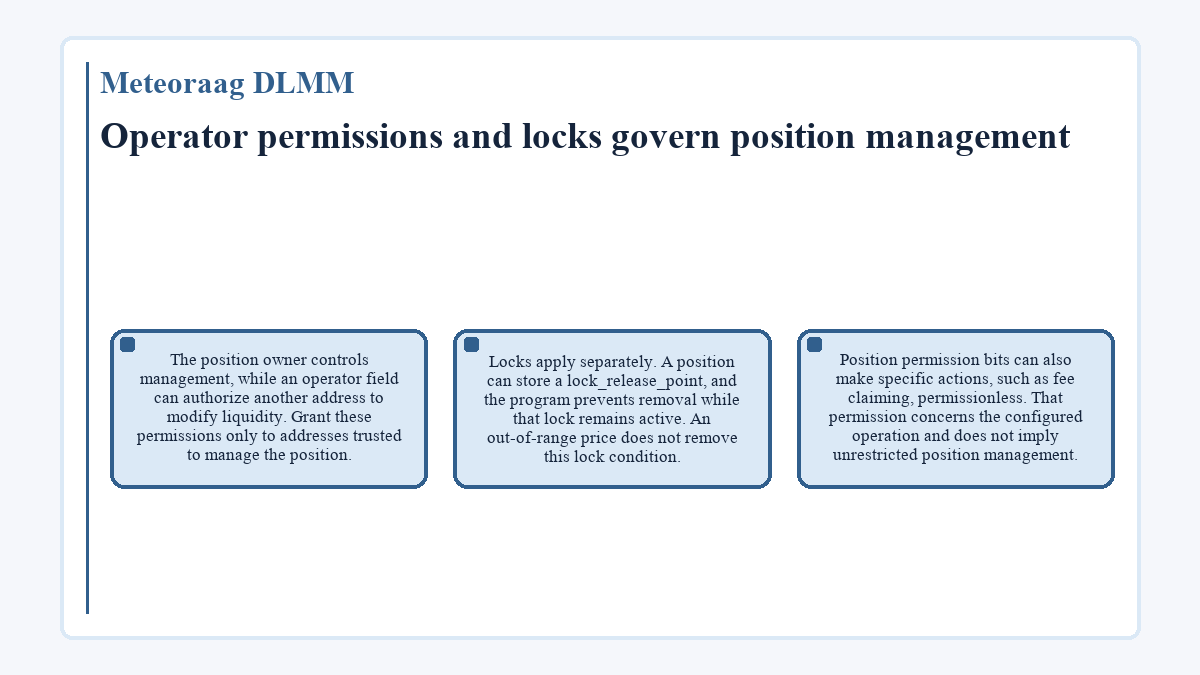
The position owner controls management, while an operator field can authorize another address to modify liquidity. Grant these permissions only to addresses trusted to manage the position. Locks apply separately. A position can store a
lock_release_point
, and the program prevents removal while that lock remains active. An out-of-range price does not remove this lock condition. Position permission bits can also make specific actions, such as fee claiming, permissionless. That permission concerns the configured operation and does not imply unrestricted position management.
Liquidity mining and limit orders require different pool modes
Liquidity mining mode enables funded reward tokens for eligible active liquidity, while limit-order mode enables bid-side or ask-side order liquidity in selected bins. A liquidity mining pool does not support limit-order placement, and a limit-order pool does not support liquidity mining rewards. For older or undetermined configurations, initialized reward information determines whether liquidity mining is active. If it is not active, the program supports limit-order behavior.
A single-sided LP deposit can support gradual buying or selling through price movement. Native limit-order placement adds the separate requirement of a pool that supports limit orders.
Meteoraag DLMM: what people ask
Is the DLMM bin step the same as its trading fee?
The bin step measures price spacing, while the trading fee charges for swaps. Basis-point notation can describe either parameter without making them interchangeable. The DLMM program supports bin steps up to 400 basis points. The base fee and any configured variable fee determine the trading charge; both calculations use the bin step.
Does an out-of-range DLMM position earn Dynamic Vault lending interest?
DLMM liquidity does not enter Dynamic Vault lending strategies, including when a position leaves its active range. Its income mechanisms involve trading fees and eligible pool incentives. Moving outside the range does not redirect the deposited assets into lending or create a replacement source of interest.
Where do claimed DLMM fees go when a position has a separate fee owner?
A separate fee owner controls the destination for claimed fees on positions that use this feature. Position ownership, operator permissions and fee ownership describe different controls. The presence of an operator does not by itself establish that operator as the recipient of claimed fees.
Why can a DLMM position remain open after its liquidity is removed?
Closing a DLMM position requires clearing its liquidity, fees and rewards. Removing deposited liquidity alone may leave claimable balances in the account. Those outstanding balances keep the position from meeting the closure condition, even though the position no longer supplies tokens for swaps.
Are Meteoraag DLMM liquidity positions represented by NFTs?
DLMM represents liquidity ownership through dedicated position accounts, without issuing a position NFT or fungible LP token. DAMM v2 uses position NFTs instead. Transferring a DAMM v2 position NFT transfers control of that position; this ownership mechanism does not describe how DLMM position accounts work.