 Meteoraag
 DAMM pools use LP tokens or position NFTs to represent liquidity ownership
Meteoraag DAMM uses liquidity provider (LP) tokens in legacy v1 pools and position NFTs in v2 pools to represent liquidity ownership. Both versions support token swaps on Solana through different reserve structures and fee accounting. DAMM v1 combines automated market maker (AMM) pricing with Dynamic Vault positions. DAMM v2 supports fixed concentrated ranges or full-range compounding liquidity, with configurable fees, rewards and locks.
- updatedA fee balance does not describe all value accruing to liquidity. Some income stays claimable, while compounding reinvests an allocated share. Pool boundaries and liquidity locks also determine which swaps or withdrawals the configuration permits.
DAMM v2 compounding pools reinvest the configured share of LP fees into full-range reserves, leaving any remainder claimable.
Liquidity deposits support swaps through a shared pricing curve
A liquidity deposit supplies assets that traders swap against, while the DAMM version determines the ownership record that tracks the provider’s share. Each pool connects two token mints through its pricing model. Trades change the reserve composition, so withdrawing liquidity can return a different token mix from the original deposit.
Full-range constant-product pools price swaps through the relationship x × y = k between reserves. DAMM v1 also supports amplified StableSwap curves for closely related assets and depeg-aware SOL/LST pools. An LST is a liquid staking token. These curve choices affect pricing separately from how the pool records ownership.
LP tokens and position NFTs connect providers with liquidity
In v1, fungible LP tokens represent a proportional pool share. The AMM itself holds Dynamic Vault positions for each token side. Its calculations convert those internal vault shares into underlying token amounts when pricing swaps, processing withdrawals or calculating pool-share value.
DAMM v2 separates the ownership token from the accounting record. A Token 2022 non-fungible token (NFT) identifies position ownership, while the position account tracks liquidity, pending fees, rewards and locks. Transferring a DAMM v2 position NFT transfers control of that liquidity position.
Positions can also split, allowing separate ownership of liquidity tranches without closing the original position.
The NFT standard describes the position token. Pool assets have their own mint programs and compatibility requirements, so a Token 2022 ownership NFT does not require both traded assets to use Token 2022.
Concentrated DAMM v2 liquidity follows pool-wide price boundaries
A concentrated DAMM v2 pool sets a minimum and maximum price at creation, limiting the range in which its liquidity supports swaps. These boundaries apply to the pool. DLMM uses discrete price bins to organize liquidity; DAMM v2 concentration defines a shared AMM range.
An exact-input swap that would move beyond a boundary fails unless it uses the supported partial-fill path. Concentration can increase capital efficiency within the chosen range, while the configured boundaries constrain how far a swap can move the price.
Does DAMM v2 automatically reinvest every LP fee?
DAMM v2 automatically reinvests LP fees only in Compounding mode, and the configured share determines how much returns to reserves. A compounding pool uses full-range constant-product liquidity. It cannot combine this mode with a custom concentrated range.
The pool removes the protocol fee before dividing the remaining LP fee into compounded and claimable portions. The compounded portion increases token B reserves. Position owners can claim the remainder, provided the configuration leaves a remainder to claim.
compounding_fee_bps
measures the reinvested share in basis points of LP fees. Compounding pools require a positive value no greater than 10,000. At 10,000, the pool compounds the entire LP fee and leaves no claimable LP-fee portion. BothToken and OnlyB pools require this parameter to equal zero.
Compounding pools also have a special initialization rule. Initial liquidity must exceed the program’s dead-liquidity amount, which remains in total pool liquidity but does not belong to the first position. Consequently, the first position receives less liquidity than the raw initialization amount.
Fee settings separate trading charges from revenue splits
A DAMM v2 trading fee combines the selected base fee with an optional volatility-based dynamic fee, subject to the applicable pool cap. Time schedulers can keep the base fee fixed or reduce it over time. Market-cap schedulers reduce the base fee as the square-root price rises through configured steps above its initial value. After expiry, they use the final-period fee. Both scheduler families support linear and exponential curves.
Rate limiter mode is deprecated for new configurations and new pools; existing rate-limiter pools can still trade. BothToken collection can accrue fees in either pool asset. OnlyB and Compounding collect fees in token B, commonly the quote asset. The collection mode and swap direction determine whether the charge comes from input or output.
The protocol share defaults to 20% of the trading fee. When a referral is present, its default share equals 20% of the protocol fee. LP fees comprise the trading fee after the protocol deduction. These percentages describe fee revenue allocation, not percentages of the entire liquidity balance.
Legacy vaults and farms contribute different income
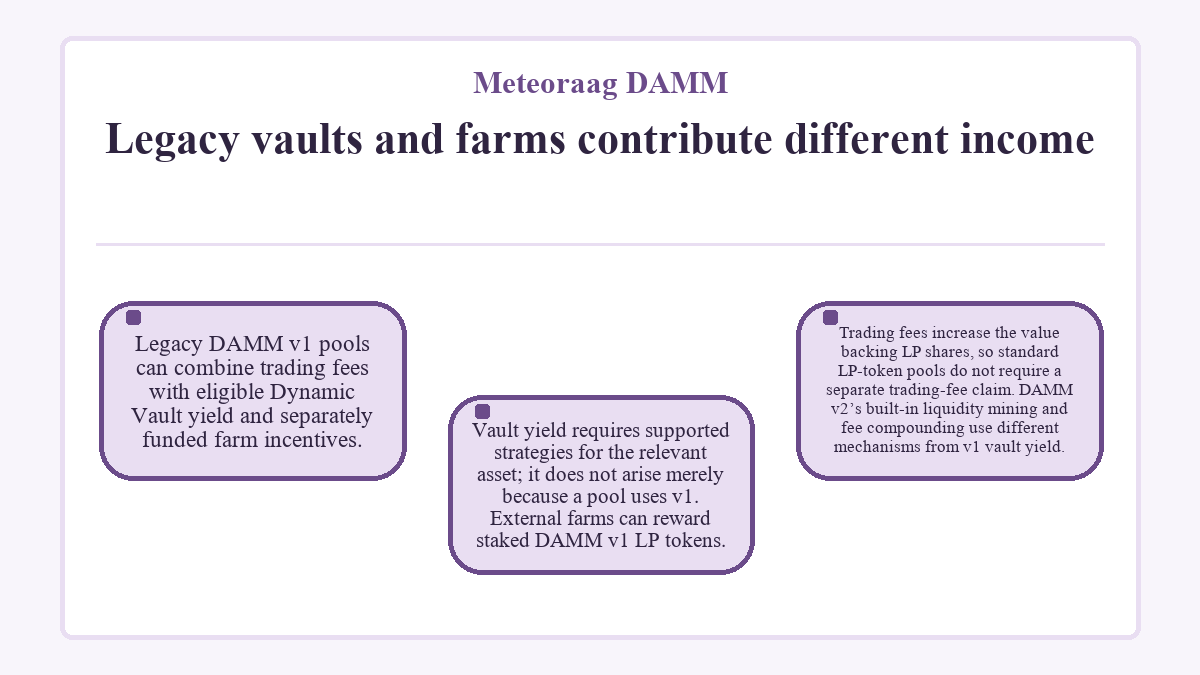
Legacy DAMM v1 pools can combine trading fees with eligible Dynamic Vault yield and separately funded farm incentives. Vault yield requires supported strategies for the relevant asset; it does not arise merely because a pool uses v1. External farms can reward staked DAMM v1 LP tokens. Trading fees increase the value backing LP shares, so standard LP-token pools do not require a separate trading-fee claim. DAMM v2’s built-in liquidity mining and fee compounding use different mechanisms from v1 vault yield.
Which Token 2022 checks apply to DAMM v2 pool assets?
DAMM v2 validates Token 2022 mints through the permissionless extension allowlist, a valid token badge or an authorized private-config exception. Standard SPL Token mints and Token 2022 mints without extensions qualify permissionlessly. The allowlist also includes TransferFeeConfig, MetadataPointer and TokenMetadata. A TransferHook extension qualifies permissionlessly only when both its hook program ID and authority are unset. Other extensions can require badge review. A badge permits mint validation, but an active hook can still make transfers fail because DAMM v2 does not forward the extra accounts that transfer hooks require.
For
initialize_pool
and
initialize_pool_with_dynamic_config
, a private config can skip these checks through
CreatePoolWithoutMintValidation
.
initialize_customizable_pool
still requires allowlisted extensions or a valid badge. The Token 2022 native mint remains unsupported even with a badge or validation bypass. SOL liquidity uses the standard wrapped SOL mint.
Rewards and liquidity locks use position-level accounting
A DAMM v2 pool can distribute up to two funded reward tokens through its own program, with allocations based on each position’s share of total liquidity. This accounting avoids the separate farming program that legacy v1 pools can use. Reward income depends on the pool’s funded campaign.
Positions can contain unlocked, vesting and permanently locked liquidity. Vesting liquidity unlocks according to its schedule; permanently locked liquidity cannot be withdrawn. Both can continue earning fees and rewards. Transferring ownership does not remove those restrictions. Supported claim actions can route eligible DAMM v2 fees or rewards into a PDA Dynamic Fee Sharing vault.
Pool settings explain differences in visible fee balances
A small claimable balance can reflect different accounting rules across DAMM versions. To interpret that observation, identify the ownership format and fee-collection mode before treating the balance as total fee income.
- A DAMM v1 LP-token pool reflects trading-fee income in pool-share value.
- A DAMM v2 position in BothToken or OnlyB mode accumulates LP fees as claimable balances.
- A DAMM v2 Compounding pool adds its configured LP-fee share to reserves.
- If that share consumes the whole LP fee, no LP-fee remainder stays claimable.
- Funded liquidity mining tracks rewards separately from trading fees.
Previously claimed fees no longer form part of the pending balance.
Everyday questions about Meteoraag DAMM
-
What does base APY measure in Meteoraag DAMM v1?
- DAMM v1 base APY annualizes the change in a pool share’s virtual price over a measurement window. Virtual price equals the curve invariant divided by LP token supply after converting vault shares into underlying token balances. Swap fees and eligible Dynamic Vault yield can increase it. The figure describes past pool-share performance over that window.
-
How do DAMM v1 standard and stable-swap trading fees differ?
- DAMM v1 standard constant-product pools charge a trading fee of 0.25% of the swap input, split into a 20% protocol share and an 80% LP share. Stable-swap pools charge 0.01% of input, with all of that fee allocated to LPs. Launch constant-product pools allow customizable trading fees, so the standard rate does not apply universally.
-
Where does DAMM v2 collect a fee in OnlyB mode?
- In OnlyB mode, DAMM v2 takes fees from token B output on A-to-B swaps and token B input on B-to-A swaps. Collection therefore stays in B when the direction changes. Token B is commonly the quote asset; the pool’s mint assignment determines which asset that means.
-
Why can an existing DAMM v2 pool still have a rate limiter?
- Existing DAMM v2 pools can retain rate-limiter configurations because the deprecation applies to new configurations and new pools. During the configured limiter window, fees can depend on buy size. Rate limiter mode requires OnlyB fee collection.
-
Are SOL requirements identical for every DAMM pool creation?
- SOL requirements vary with the accounts that pool creation must open and the transaction fees that it incurs. DAMM v1 and v2 creation can require rent for associated token accounts. This account funding is separate from the tokens supplied as liquidity, so a creation estimate is not a universal liquidity requirement.
-
How do Token 2022 transfer fees affect DAMM v2 deposits?
- When a deposit needs a target post-fee vault amount, DAMM v2 calculates the fee-inclusive amount that the user must send. Transfer-fee accounting also applies to withdrawals, swaps and reward funding. For flows that calculate received amounts, the program determines the post-fee result using the token’s current epoch transfer fee. When the current epoch transfer-fee rate is 100%, the program adds the mint’s maximum transfer fee to a positive post-fee target to calculate the amount to send.
-
Will a DBC token badge also satisfy DAMM v2 badge checks?
- A Dynamic Bonding Curve (DBC) token badge does not substitute for a DAMM v2 token badge. For DBC migrations into DAMM v2, destination configurations carry CreatePoolWithoutMintValidation and allow initialization without a separate DAMM v2 badge. The Token 2022 native mint remains unsupported under that permission. Transfer-hook execution restrictions also remain in place.